Marma massage is an ancient, touch-based Ayurvedic therapy that works with the body’s vital energy points to rebalance prana, release tension, and restore whole-body harmony. Rachel Markowitz explores the benefits of marma, and why this timeless healing method is gaining fresh modern appeal.
Marma therapy, a method of touch-based energy healing, is an integral component of the age-old Indian science of health, Ayurveda. Known as the “sister science” of yoga, Ayurveda encompasses traditional philosophies and practices that support our holistic wellness – health of the body, mind, and spirit. According to Ayurveda, a person’s physical, mental, or emotional state is seen as a reflection of how prana, our life force energy, flows or stagnates in the body.
Marma therapy, or marma chikitsa in Sanskrit, is a practice based on anatomical points of vital energy called marmas. Marmas serve as a link between the physical body and the subtle (energetic) body. Through marma therapy, we can harness these points to stimulate energy centers, release blockages, and balance prana for optimal health.
History of Marma Therapy
Marma therapy is more than a bodywork session; it’s a comprehensive practice for balancing the three “humors,” or doshas, that underpin Ayurvedic science. The doshas are related to our elemental composition – vata (air and ether), pitta (fire and water), and kapha (earth and water) – and each person is comprised of a unique ratio of these distinctive energies.
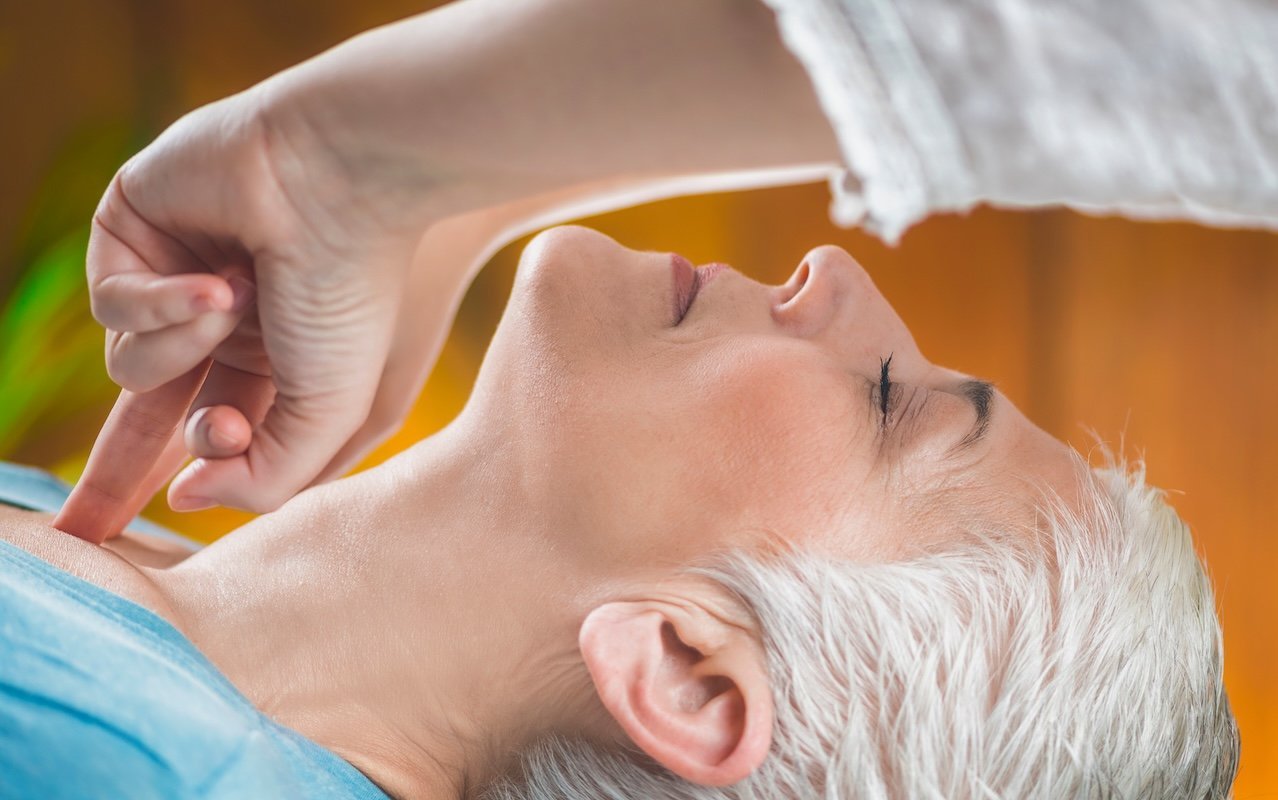
Marma Chikista is a touch-based Ayurvedic therapy
The background of marma therapy, which dates back thousands of years (at least since 1500-2000 B.C.), might seem surprising: marma points and marma healing were originally used in ancient martial arts and warfare. History suggests that these points were first discovered through the practice of Kalari, a traditional martial art from Kerala in southern India.
MORE LIKE THIS:
- Guide to Healing Touch Therapy and Massage
- The Essentials of Energy Healing: 10 Techniques
- 14 Different Types of Reiki: Which is Best For Me?
According to references throughout Vedic scriptures, ancient warriors utilized marma points for attack (piercing some marmas inevitably leads to unconsciousness or death!), trained to protect their own vital marmas, and learned to use these points for combat-related healing and recovery.
“Marma therapy, a method of touch-based energy healing, is an integral component of the age-old Indian science of health, Ayurveda.”
However, the foundations of using marmas for medical and therapeutic purposes were first documented in the Sushruta Samhita, a 4th-century scripture that identified, classified, and standardized marma points and their healing qualities. In modern day, these points, identified and mapped thousands of years ago, still play an integral role in most Ayurvedic healing practices.
What are Marma Points?
According to Marma science, using marma points to balance our internal elements is the key to unlocking health and vitality. The Sushruta Samhita identifies and maps out 107 points (although Tamil tradition cites 108 locations, and others many more). These points are identified on the surface of the body at meeting places of bones, muscle tissues, joints, ligaments, blood vessels, and energetic pathways. These junctions are located throughout the body, with a majority in the head and neck area.
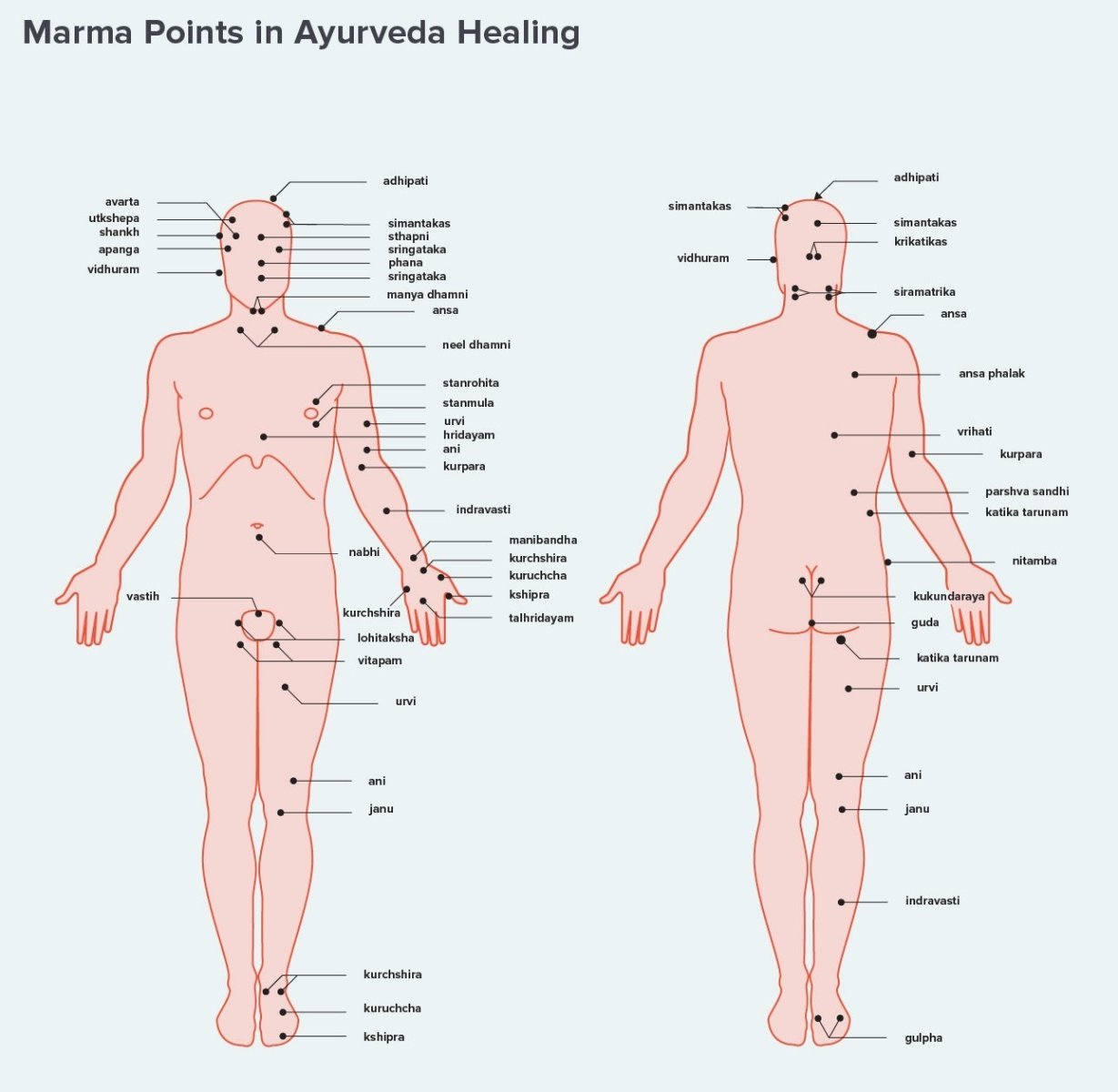
Location and name of marma points for massage
Note that although these points are located on the physical body, they are, more importantly, energy centers that can be used to redirect and store prana and balance the three doshas. In fact, Vedic scholar and teacher Maharishi Mahesh Yogi called these points a “cosmic switchboard,” serving as a bridge between the energy of the individual and that of the Universe.
Essentially, by touching or pressing marmas, we trigger changes in our biochemical composition, allowing for transformation in our physical and neurological makeup. Thus, marma chikitsa involves stimulating or manipulating these points through massage or pressure – either by hand or with a special tool called a Kansa wand.
“By touching or pressing marmas, we trigger changes in our biochemical composition, allowing for transformation in our physical and neurological makeup.”
Marma points are often compared to the acupressure points of Traditional Chinese Medicine (TCM). However, there are significant differences between these two systems. Whereas acupressure and marma points both exist along energetic channels (known as meridians in TCM and nadis in Ayurveda), marma points are relative to an individual’s body, measured by finger-widths. The size and location of marma points differ from person to person, and are more precise than acupressure points.
Benefits of Marma Massage
Marma therapy is a non-invasive practice that can improve holistic well-being and our connection to the elements, within us and around us. It’s accessible to anyone and demonstrates our natural ability to heal through touch.
Unlike conventional massage, marma massage therapy not only ameliorates or remedies ailments, but also allows us to survey our current state of being to achieve overall balance. Marma massage is unique to each individual, and its benefits encompass all levels of being:
-
Physical: Marma massage is particularly useful for pain management and muscle tension, and studies cite evidence-based relief for lower back and knee pain-related issues, tension headaches, and arthritis. It also enhances the immune system, increases circulation, detoxifies the body through lymphatic drainage, and improves the functioning of internal organs and organ systems.
-
Mental/emotional: Marma massage facilitates self-awareness, improves sleep, and promotes positive mood shifts. Research published in the Integrative Ayurvedic Medical Journal concludes that marma therapy encourages emotional healing, reduces stress, and improves cognitive abilities.
- Energetic/spiritual: Marma points help us identify and release energetic blockages, increasing and sustaining our vital energy. They encourage us to explore the energetic dimensions of our well-being and the connection between the physical and subtle body.
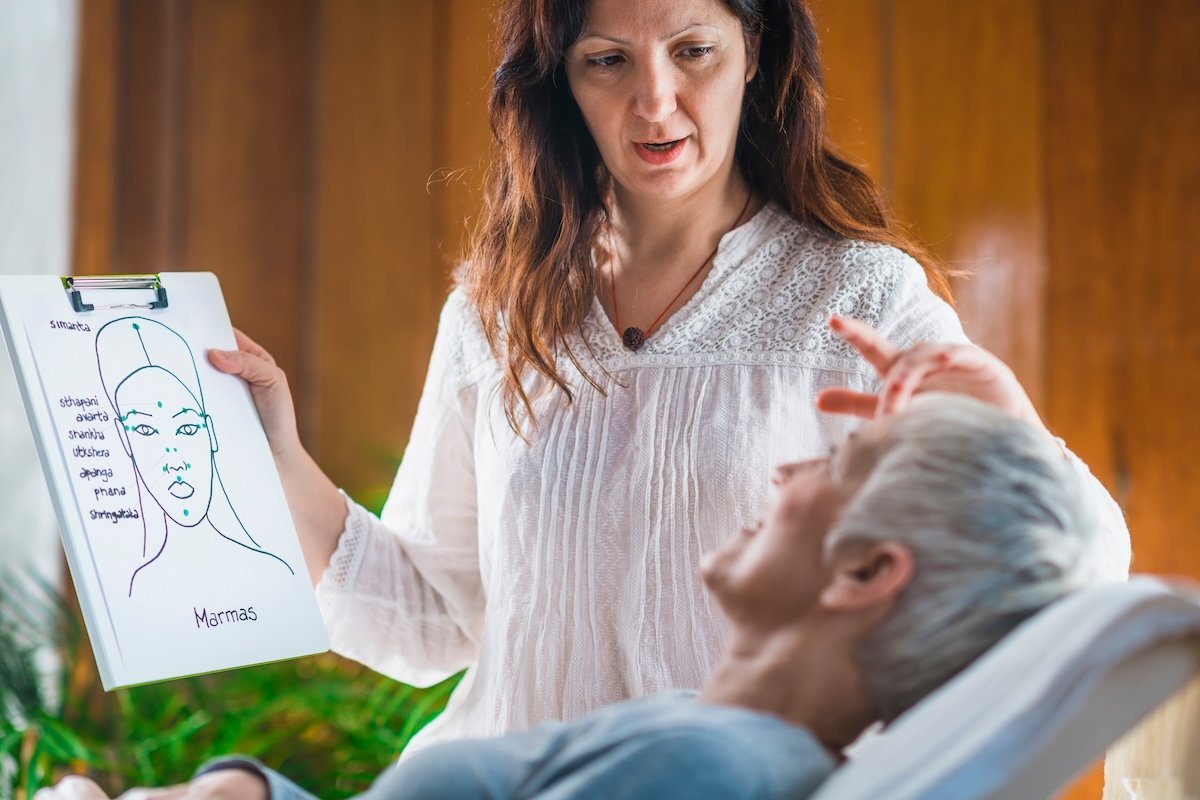 Marma point massage can release blockages and stimulate life force energy
Integrating Marma Therapy With Other Modalities
Marma therapy can be performed on its own or incorporated into other practices or treatments to enhance their effectiveness. For example:
-
Marma points are naturally integrated into full-body Ayurvedic massage (abhyanga) to affect internal organs. In fact, most Ayurvedic massages reference marma points to balance and heal.
-
Marma science can guide yoga therapy sessions, employing particular physical postures and breathwork practices to stimulate or unblock certain energetic points.
-
Marma massage is often combined with aromatherapy or herbal medicine for comprehensive healing treatments. The practice of applying an herbal paste on a marma point or area, typically to reduce pain or swelling or promote joint health, is called lepa chikitsa.
-
Marma therapy helps detoxify the body and is often used before and during complete Ayurvedic cleanses, known as Panchakarma treatments.
- With a basic understanding of marmas, we can take advantage of their healing benefits – as part of a daily self-care ritual or in moments of discomfort or stress.
FAQs: Marma Therapy
What Is Marma Therapy And How Does It Work?
Marma therapy is an Ayurvedic healing method that stimulates approximately 107 vital energy points (marmas) to balance prana, enhance circulation, calm the nervous system, and support whole-body wellness.
Is Marma Therapy Safe For Everyone?
Marma therapy is generally safe when performed by a trained Ayurvedic practitioner. People who are pregnant, have serious injuries, uncontrolled health conditions, or are recovering from surgery should seek medical advice before trying it.
What Does A Typical Marma Therapy Session Involve?
A session marma therapy session includes gentle pressure or massage on marma points using fingers or a Kansa wand. Practitioners may incorporate warm oils, aromatherapy, or herbal pastes, depending on your dosha and wellness goals.
How Much Does Marma Therapy Cost?
Pricing varies by country, practitioner, and session length, but typically ranges from €40–€120 ($45–$140) per session. Specialist Ayurvedic clinics or combined treatments (like Panchakarma) may cost more.
What Are The Benefits Of Marma Therapy?
Marma therapy may help relieve pain and stiffness, reduce stress, improve sleep, support emotional balance, boost circulation, and encourage energetic flow. Many people use it alongside yoga, meditation, or Ayurvedic massage for deeper benefits.
The Takeaway: Marma Chikitsa
Marma therapy, or marma chikitsa, is an ancient touch-based Ayurvedic therapy, derived from points of vital energy in the body. These points, which unblock, increase, and stabilize energy, are an essential component of the foundation of Ayurveda. Marma massage is an easily accessible bodywork practice that leads to holistic balance of the three doshas and a better understanding of our connection to nature. ●
Images: shutterstock/Microgen, shutterstock/Microgen
happiness.com | The fine art of being: learn, practise, share
Are you a happiness.com member? Sign up for free to enjoy:
■ our happiness magazine with practical life tips
■ sharing and supporting others in our happiness forum
Written by Rachel Markowitz
 Rachel recently found herself over a decade deep in a worldwide wander guided by what she feels to be true. She’s been facilitating classes and workshops on yoga, meditation, self-exploration, and alternative ways of living since 2012, mostly in Latin America and Asia. These days, she spends most of her time looking at, walking around, or singing to a sacred mountain in southern India. Read more of her words at her to those who wonder blog.
YOU MAY ALSO LIKE
Forum discussions
-
Healing from trauma, learning to forgive
By Be**** , in Introduction Circle - A warm welcome to happiness!
- 2 replies
- 2,037 views
-

- Al****
-
NIGHT BY THE FIRE. Relaxing music. Healing music. Meditation music. Sleep music. Yoga and relax
By Re**** , in Mindfulness & Meditation Forum
- 0 replies
- 1,914 views
-

- Re****
-
Connection to the Creator, the Source of infinite high frequency energy
By Th**** , in Mindfulness & Meditation Forum
- 0 replies
- 2,517 views
-

- Th****
-
- 0 replies
- 2,138 views
-

- He****
-
- 3 replies
- 3,835 views
-

- Wi****
Join the conversation
You are posting as a guest. If you have an account, sign in now to post with your account.
There are no comments to display.